There's been some discussion on the email list about the name of our group, and I'd like to throw in my two cents here.
To say that someone is a skeptic does not say much about that person's religious beliefs, or lack thereof. In fact, it may be that religion is the farthest thing from that person's mind. As an atheist, I lack belief in a god or gods. But that can be a pretty boring topic of conversation time and time again. Morally, I align myself with much of secular humanism, but I'd rather do good things than talk about what is good. No, I was never so great at philosophy.
Skepticism, for me, is a whole other ball game. To be a skeptic is to challenge and question everything, whether it be belief in a god, talking to ghosts, alternative medicine, or a new product that is being sold on a television commercial. Every person uses a bit of skepticism when making every day decisions, and everyone can stand to use a bit more. For this reason, I think that to be a skeptic is the most practical way to be, and that skepticism is actually the most inclusive term. Anyone can apply observation and critical thinking skills to a problem, even if it does take time to hone those skills. A person armed with a "baloney detection kit" at all times is acting as a skeptic. Most of us will have our skeptical alarm bells set off if a stranger in a parking lot offers to hold our purse while we load groceries into our car. My skeptical alarm will surely sound whenever I hear a claim for diet pills or magnetic therapy. Most people will balk if you tell them that the Virgin Mary appeared on your grilled cheese sandwich. Skeptics are the ones with the answer when someone asks, "What's the harm in believing?"
Skeptics aren't just curmudgeonly naysayers, either. Most that I've met have a deep appreciation for science, and the wonderful ways in which our universe works. For them, reality is enough to explore. There is no need for the "supernatural." Look at all the fabulous things we can learn through evidence and reason! For example, every atom in your body, that is not hydrogen or helium, was formed in the core of a massive star many billions of years ago, or in the explosive aftermath that marked its death, called a supernova. In the words of one of the greatest skeptics of the modern age, and one of my personal heroes, Carl Sagan, "The Earth and every living thing are made of star stuff." I highly recommend Sagan's Demon Haunted World to anyone for an introduction into Sagan's thought processes, and I have a copy that is available to borrow!
So, I guess that's why I'm happy with the name Skeptics' Group, or Skeptics' Society, or CVille Skeptics, or Skeptical Badasses, whatever sounds coolest. It's a positive way of saying, "we're a thinking bunch of people, and nothing is safe from our rational approach to life!"
I'd also encourage you to check out a longer article, "What is Skepticism?" by Sam Ogden over at Skepchick. It talks abut skepticism as a handy-dandy toolkit for investigating claims, whether it be everyday or not-so-ordinary, and how it is like "science express."
Thursday, January 29, 2009

Monday, January 19, 2009
Seen at Barnes & Noble:

At first I assumed it's just kind of a gift-type item; sort of just for a giggle.
Then I realized, maybe not? I just can't fathom that someone would take a bible hunting (and also need that bible to be invisible by deer), so perhaps it's for fashion? Why take a plain old brown bible to church, show everyone you are a hunter with your camo bible!
Yes, I will whip out my camera at Barnes & Noble in the name of blogging. :-)
Thursday, January 15, 2009
Life on Mars?
NASA announced today the discovery of plumes of methane cropping up over various spots of the Martian surface. Such a phenomenon is most likely caused by recent geological or biological activity. Either one would be scientifically interesting, but to find microbial life living on Mars right now would have a huge impact on how we view our existence as a species. Is life so common that it independently sprang up on adjacent planets? Did one planet "seed" the other with life? How tenacious is life, and how well can it survive is seemingly inhospitable environments?
Methane out gassing on the Red Planet has been puzzling planetary scientists for some time. Today we find that there is more of it that was expected, and that the abundances change with the seasons. Read more about this story from, some of my favorite bloggers: AstroEngine, SpaceWriter, SarahAskew, and Universe Today. Don't forget, of course, the official NASA press release!

Let's not get ahead of ourselves, now. Remember, in 1996, images of possible microbes in a sample of Martian rock (ALH84001) captured the public imagination. Today, after extensive testing of the samples, most scientists are convinced that the structures are non-biological in nature. So although the possibilities are tantalizing, we must remember to ground ourselves in science and be very thorough before making sweeping conclusions.
There is still a lot of science to be done and great results to discover, even if they aren't paradigm shattering. Hopefully, these areas of methane enhancement will be targets for future rovers and landers.
Methane out gassing on the Red Planet has been puzzling planetary scientists for some time. Today we find that there is more of it that was expected, and that the abundances change with the seasons. Read more about this story from, some of my favorite bloggers: AstroEngine, SpaceWriter, SarahAskew, and Universe Today. Don't forget, of course, the official NASA press release!
Let's not get ahead of ourselves, now. Remember, in 1996, images of possible microbes in a sample of Martian rock (ALH84001) captured the public imagination. Today, after extensive testing of the samples, most scientists are convinced that the structures are non-biological in nature. So although the possibilities are tantalizing, we must remember to ground ourselves in science and be very thorough before making sweeping conclusions.
There is still a lot of science to be done and great results to discover, even if they aren't paradigm shattering. Hopefully, these areas of methane enhancement will be targets for future rovers and landers.
Tuesday, January 13, 2009
Old petition to ban movie "Religulous" from Cville

OH NO!
http://www.thepetitionsite.com/1/ban-and-boycott-the-movie-religilous-from-charlottesville
Total signatures (brace yourself): 11.
Total signatures from Charlottesville: 0.
FAIL!
Monday, January 12, 2009
Podcast alert

UVA Astronomy Professor Ed Murphy with the top 8 space stories of 2008
Click!
http://www.cvillepodcast.com/2009/01/11/ed-murphy/
Does religion make you nice?

I just wanted to post a link to this brief but very interesting article on Slate.com, "Does Religion Make You Nice."
The end is particularly poignant. The author notes that Danes and Swedes are particularly happy countries despite their rampant godlessness, but also points out that they still attend church (they just don't believe in God.) This points to the importance of community.
This highlights the importance, then, of groups like The Cville Skeptics! And it also gives some value to the possible group motto of "A church for the rest of us," which I couldn't decide if it was appropriate or not. ha!"American atheists, by contrast, are often left out of community life. The studies that Brooks cites in Gross National Happiness, which find that the religious are happier and more generous then the secular, do not define religious and secular in terms of belief. They define it in terms of religious attendance. It is not hard to see how being left out of one of the dominant modes of American togetherness can have a corrosive effect on morality. ...
"The sorry state of American atheists, then, may have nothing to do with their lack of religious belief. It may instead be the result of their outsider status within a highly religious country where many of their fellow citizens, including very vocal ones like Schlessinger, find them immoral and unpatriotic. Religion may not poison everything, but it deserves part of the blame for this one."
Saturday, January 10, 2009
Molecule self-replicates in lab
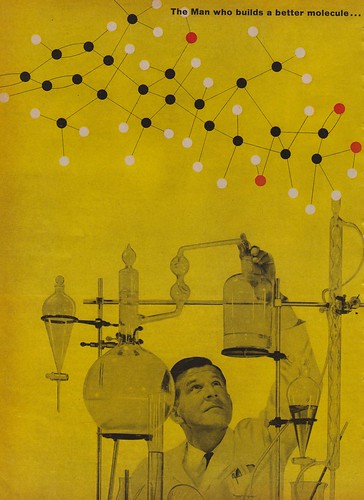
IT'S ALIVE!!!!
"Obviously what we're trying to do is make a biology," says Gerald Joyce, a biochemist at the Scripps Research Institute in La Jolla, California. He hopes to imbue his team's molecule with all the fundamental properties of life: self-replication, evolution, and function.
Whole story:
http://www.newscientist.com/article/dn16382-artificial-molecule-evolves-in-the-lab.html?DCMP=OTC-rss&nsref=online-news
Photo credit
Subscribe to:
Posts (Atom)

 Posts
Posts